If you see a person on the street talking out loud to themselves you might instinctively want to keep your distance.
You may ask yourself: if they’re the ones saying it doesn’t that mean they already know what they’re going to respond, so then why do they need to speak out loud to themselves?
But we also have a voice in our heads that is going on in the background all the time. Maybe we don’t verbalize it, but is this really that different from that person talking to themselves?
This voice has full conversations, argues with itself, judges everything and everyone around you, and always narrates what’s going on.
Most of the time we’re not aware of it, but sometimes it may be chatting so much that we get frustrated with it and tell it to shut up. Like when we’re trying to go to sleep but your mind won’t stop.
But this doesn’t work because that’s just the voice yelling at the voice. The only effective way to get it to quiet down is to step back and view it objectively.
It’s easier to make that distinction when it’s saying negative things, but when it’s saying nice things we will want to identify with the voice.
We must realize that regardless of what it’s saying, the voice is not us, we are the ones experiencing the voice. We are the subject, the voice is the object.
The voice is there because it is trying to create a sense of control to make us feel more comfortable. Like backseat driving, it gives us an illusion of control over the outside world.
It especially ramps up when something is wrong. Like a tea kettle, the energy inside us builds up to the point it needs a release and the voice serves as the release valve mechanism within us.
If something happens externally that stirs up your energy, your voice can complain and judge it internally and it gives you a sense of relief and control over the situation.
But by taking a step back and observing the voice in your head, you will realize that none of our thoughts have any effect on reality. The problem is never what is happening outside the mind, but the commotion within it.
So the only logical way to get rid of your problems is to get rid of the part of yourself that seems to have so many problems. If you notice the voice going off about something ask yourself: what part of me has a problem with this?
Inner Roommate Visualization
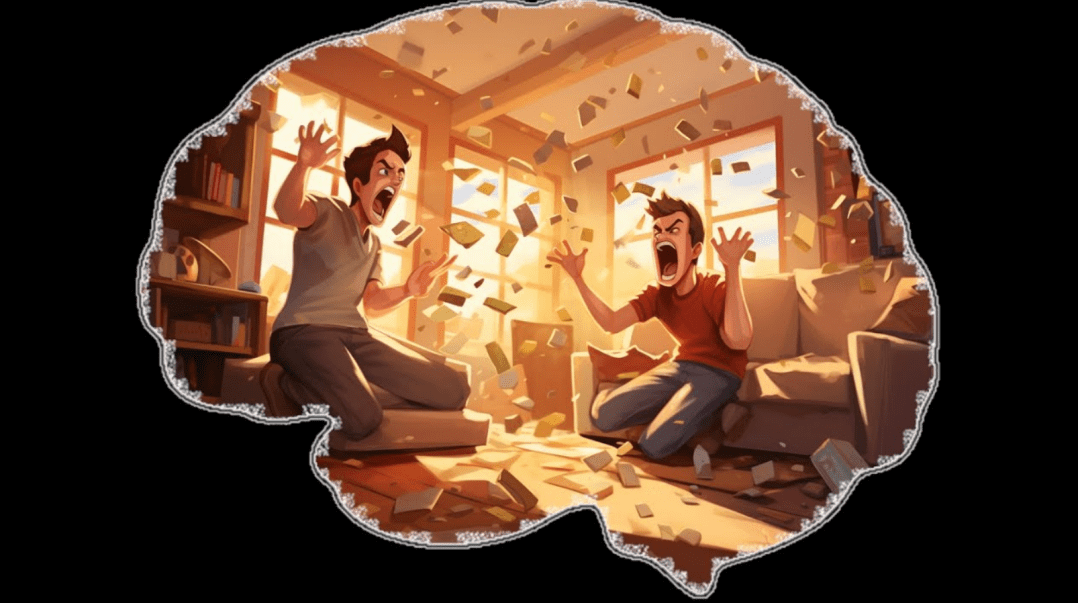
A good way to make this more tangible is to visualize the inner voice as a roommate. Your mind is your home but you’re living in there with your inner voice. I call mine Diego.
Make the intention to sit in silence within your inner domain for 2 minutes and see what happens. You will see that your inner roommate pipes in almost immediately.
If you do this long enough you will notice that your roommate seems to have a problem with something just about all the time. It is very quick to jump in with judgements and criticisms. It changes its stance very easily and when it does it never admits it was wrong.
An example: let’s say you texted your partner and don’t hear back as quickly as usual. At first your roommate comes to the rescue by saying they’re probably busy or they forgot.
But when a few hours turns into almost the whole day, then it changes its tune.
Now it says that they’re being rude, maybe they’re pulling away and you need to protect yourself, maybe they don’t feel the same way you do.
It tells you that once they finally do reach out, you shouldn’t respond for a while just to teach them a lesson.
After you’ve decided your relationship is basically over you get a call from them telling you that they’ve been working all day on a surprise for your anniversary and to be ready in an hour because they’re picking you up for a surprise adventure.
Now your inner roommate is over the moon, saying all these things about how great your partner is and how much you love them.
But wait a minute, didn’t it put you through hours of turmoil for nothing? Is it just going to move on and pretend it never happened? Yes. That’s exactly what it will do.
By personifying your inner roommate you will be able to create a more tangible subject and object relationship, to see that it is something that is happening within you and you’re the one that is aware of it.
The next step is to ask yourself: if this were a real person would you go to them for advice? Would you make important life decisions based on their input?
This roommate is in there with you regardless of what you do, so your only option is to make them your best friend and love them unconditionally.
But you can view it as you would your own child: with love, compassion, and understanding even when it acts up or tries to harm you since it doesn’t know better, and when it tells you stuff you let it speak but you don’t make any important life decisions based on their input.
This sense of separation allows you to begin the process of waking up from the illusion of ego. Instead of getting taken away by the illusion you are able to watch it and in a sense control it, instead of the other way around.
This will change how you approach life completely. Think about when you’re really engrossed in a TV show or video game and lose yourself in it. We come back to reality and look at the clock not realizing where we went.
This is also how we live our lives: lost in the melodrama of our own minds, coming back into the reality of the present moment from time to time.
But if we can take a step back and observe it objectively, we will realize that what goes on in the mind is as real as a video game or a TV show and can choose how to act accordingly.

 The JJ Experiment